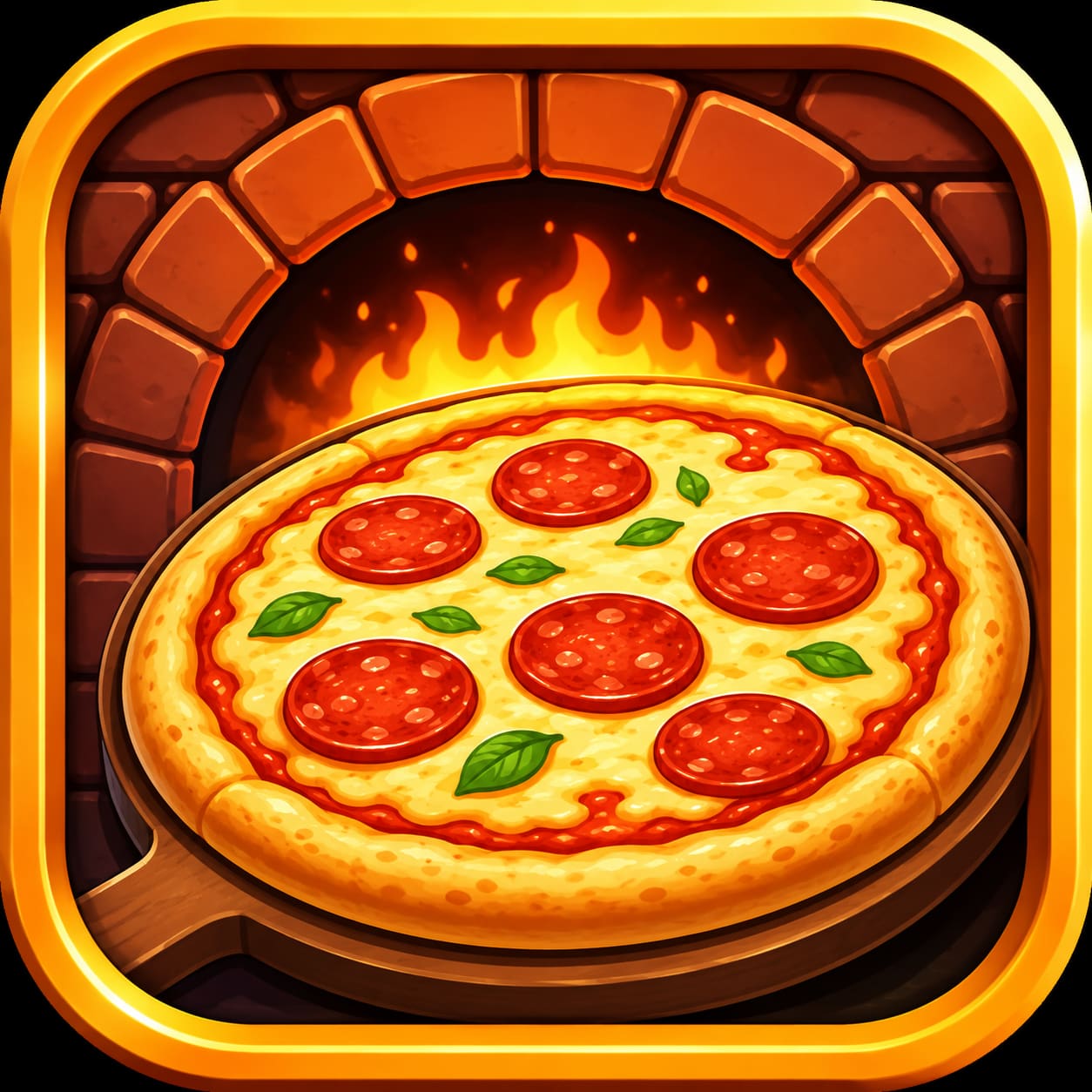
Firecrust is a free browser pizza game about running one wood-fired counter through an eighteen-night opening season. A customer walks up, a ticket appears, and everything after that is yours: spread the sauce, get the cheese down, place the toppings, slide the pizza into the oven and pull it out at the right moment. Every order is marked on what you actually did — what is on the pizza, how evenly it is spread, how well it is baked, how it is sliced and how long the customer stood there waiting.
The oven does not wait for you and you do not wait for it. The moment a pizza goes in, your bench is clear and the next customer’s order starts, so there is always one pie baking behind you while you build the one in front. Pulling the baked one interrupts whatever you are making and sets it aside on hold, which turns the whole night into a single repeated question: one more topping, or pull it out now? From the sixteenth night a second deck opens and two pizzas bake at once, which doubles both the throughput and the number of bars you have to keep an eye on.
The rules are what make it a game rather than a checklist. Cheese has to go on before the toppings; put it on top and the order is marked down, because nothing underneath it melted. The bake bar has a green band and a red one — pulling early leaves the base pale, and leaving it past the red burns the whole pie and takes most of the payment with it. Basil and chilli cannot go in the oven at all: they burn, so they wait for the finishing step after the bake. Meatballs are heavy enough to shove whatever is already sitting next to them, which quietly punishes crowding everything into the middle. Later tickets start reading like real orders: half-and-half, where a topping only counts on the named side, and “hold the olives”, where the mistake is putting something on rather than leaving it off.
Customers are not one behaviour with different faces. A regular gives you room. Someone in a rush pays more but has barely half the patience. A family orders more, waits longer and pays well. A critic marks nearly twice as hard as anyone else, so a pizza that would have passed elsewhere comes back as two stars. A VIP pays double and will not wait. A group is a different shape altogether: one person, two tickets, one patience bar for both. Because they all queue at once, the real decision is rarely "how do I make this perfect" — it is "who am I willing to keep waiting".
Nights interrupt themselves. The oven flares and starts baking at double speed. The power dips and it goes cold for a few seconds while three people wait. An inspector arrives and the next two orders are marked strictly. Sauce spills and the next base comes out messy. A late crowd turns up and everyone waiting gets twitchier at once. Each of these happens at most once in a night, so they read as events rather than as background difficulty.
Takings buy permanent kitchen upgrades rather than one-night consumables: comfier seats so every customer waits longer, a stone deck that widens the perfect-bake window, an extra prep hand that spaces arrivals out, and a shop sign that lifts every payment. A night that goes badly still moves the shop forward. Eighteen days make up the season, five of them judged on reputation as well as takings, and clearing day three opens the Late shift — an endless service with a saved best.
It plays with a mouse on desktop and one finger on a phone, with Space to move the bench order along, F to pull the oven and Z to undo a topping. There is no download, no account and nothing to install.
Tap an ingredient in the tray, then tap the pizza to place it — where you put it matters, because an even spread scores better than a pile in the middle. Cheese has to go down BEFORE the toppings; put it on last and the order is marked down. Press Bake it to slide the pizza into the oven.
The oven then runs on its own and your bench is free straight away, so the next customer's pizza starts while the first one bakes — that is the whole game. Watch the bar under the bench and press Pull it out (or tap the bar itself) while the cursor is between the green marks; too early is underbaked, past the red is burnt and costs you most of the payment. '. Every customer has a patience bar; when it empties they walk out and your reputation drops.
Day 3 hands you the sauce (drag across the dough, coverage is scored), day 5 adds slicing (swipe across the pizza until you have the number of slices on the ticket), day 8 brings half-and-half tickets where a topping must go on the named side only, day 9 adds a finishing step for herbs — basil and chilli burn if they go in the oven — day 11 starts asking you to HOLD an ingredient, day 12 lets you pick the dough (thin bakes fast but the green window is narrow, pan is forgiving but hogs the oven), day 14 brings groups who order two pizzas on one patience bar, and day 16 opens a second deck so two pizzas bake at once.
Meatballs are heavy and shove whatever is already next to them. Takings buy permanent kitchen upgrades: comfier seats for patience, a stone deck for a wider perfect-bake window, a prep hand to space customers out and a shop sign that lifts every payment.
 ArcadeWhale