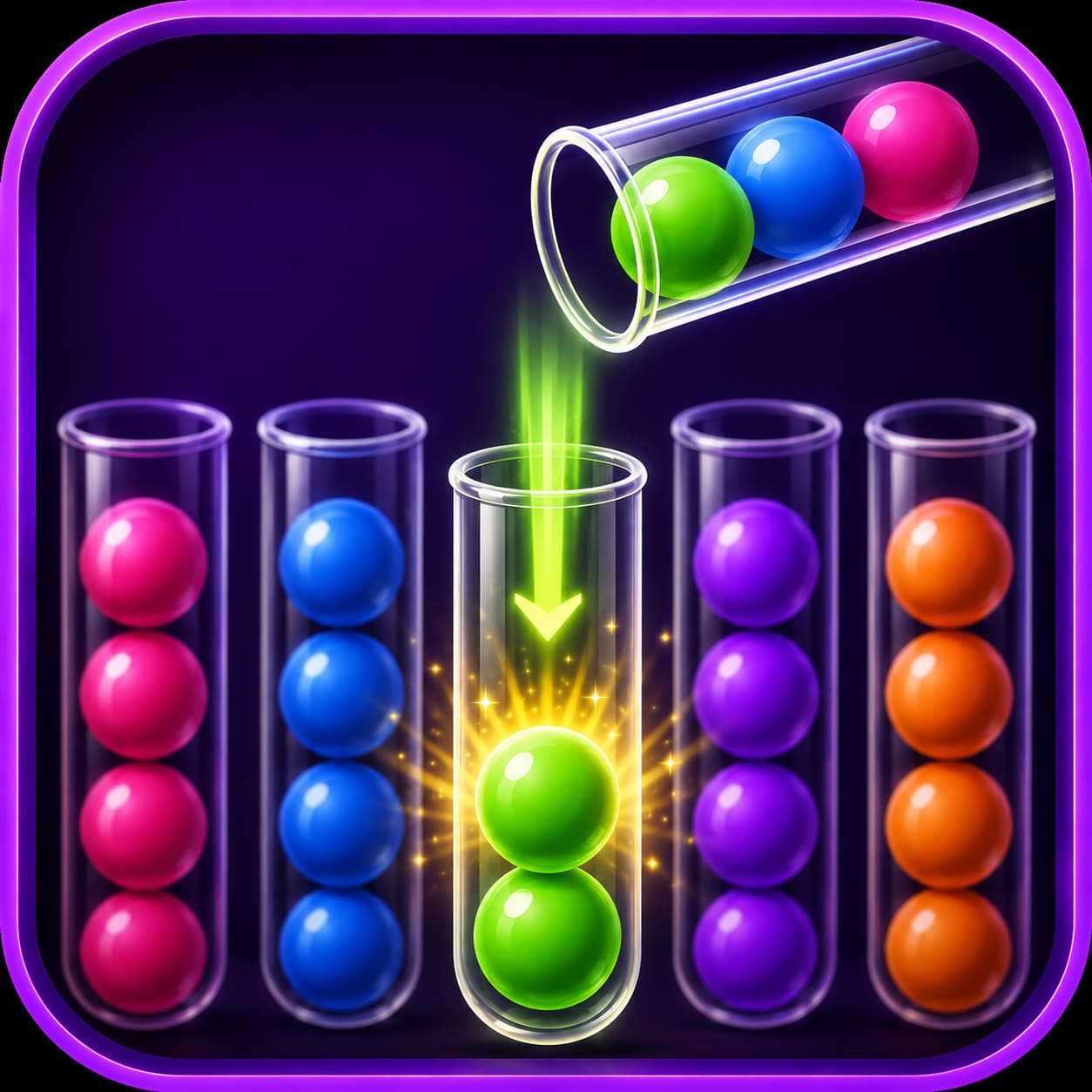
Fuse Sort takes the water sort puzzle and lights a fuse under one of the colours. Everything else about the genre is intact — pour onto matching colours or into empty flasks — but one colour is burning down a move counter, and if it runs out before that colour is fully sorted, the level is over.
That single change rewires the whole puzzle. In an untimed sorter the optimal play is patient: unblock things gradually, keep options open, get there eventually. Here patience can lose. If the fused colour is buried under three layers in four different flasks, you have to go straight at it and accept a messier board elsewhere.
So every level opens with a triage decision. Find the fused colour, count how many moves it will realistically take to gather, and compare that with the countdown. If it is comfortable, play normally and clean up as you go. If it is tight, abandon tidiness and dig.
The trap is treating the fuse as a background detail and playing the level as though it were a standard sorter. Players lose far more often to a fuse that expired while they were making the rest of the board neat than to genuinely impossible positions.
Par is the second thing worth reading. The number beside your move count is not an estimate — it is the shortest route that board allows, computed in advance, so nothing can beat it and matching it means you found the best line there is. Finishing is deliberately more forgiving than matching par, which is where the replay value sits: a level you scraped through on the last tick is still there to be solved properly.
There are 37 levels and they build from three colours in two spare flasks to ten colours across twelve, with the fuse tightening as they go. Early on the countdown is generous enough to teach the idea; from the middle of the run it binds on every board, so the triage stops being optional. Each level unlocks the next, and the grid lets you go back to any of them.
Undo, Hint and Restart are all available, and the level select lets you retry any stage. Tap a flask to pick it up and tap another to pour. On a desktop you can play it entirely from the keyboard: arrow keys move between flasks, Enter or Space picks up and pours, the number keys jump straight to a flask, and U, H, R and L cover undo, hint, restart and the level grid. Runs in the browser on desktop and mobile with nothing to install. Pour & Reveal is the same puzzle without the countdown if you would rather take your time.
Tap a flask to pick it up, then tap another to pour. A pour is only legal onto the same color or into an empty flask, and the whole run of matching balls moves at once. One color in every level glows: that is the fused color, and it has to be completely sorted before the move countdown reaches zero — every pour ticks it down, whichever flask you touch. That single rule is what makes the order of your moves a decision rather than a formality.
The number beside your move count is par, and it is not an estimate: it is the shortest route that exists for that board, worked out in advance, so matching it means you found the best line. On a desktop the arrow keys move a cursor between flasks and Enter or Space picks up and pours; keys 1 to 9 jump straight to a flask, and U undoes, H asks for a hint, R restarts, L opens the level grid.
37 levels build from three colors to ten, and each one unlocks the next. Undo and Restart are always free; if the fuse burns out, a short video buys six more moves on that board.
 ArcadeWhale