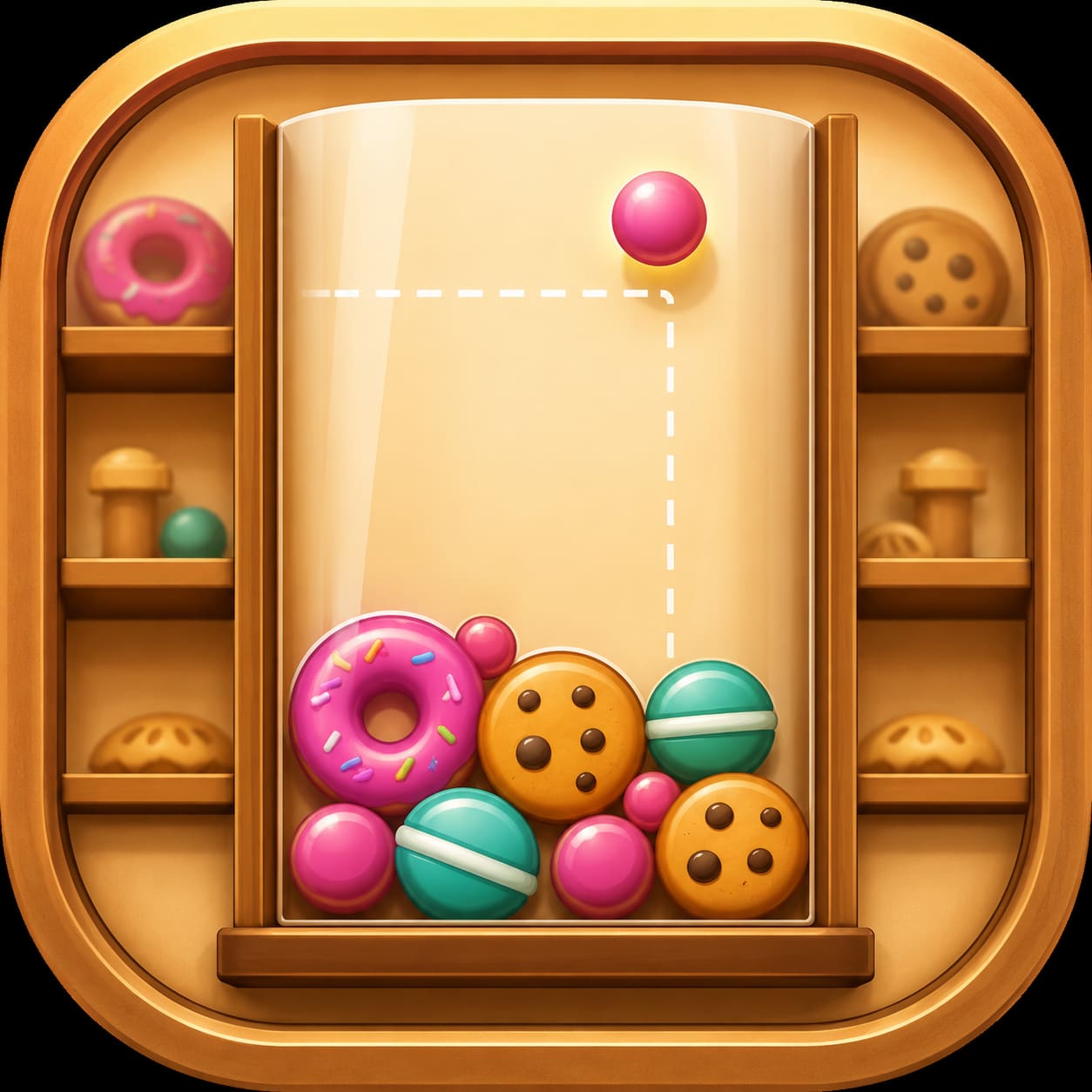
Move the mouse or your finger to aim along the tray and click to drop · A/D or arrows also slide the aim
Pastry Pile is a free browser merge game set on a bakery counter. Pastries drop into a glass tray, and any two of the same kind that touch fuse into the next treat up the chain: sprinkles become cocoa beads, beads become macarons, and eleven steps later you are looking at a Grand Gateau. Everything obeys real physics, so where a pastry rolls after it lands matters as much as where you aimed it. The only thing you must not do is let the pile rest above the dashed fill line. From the seventh shift the counter is handed over busier and that line comes down: the tray stays the same size, but the room you have to work in shrinks, and a careless late shift really can overflow.
The tension comes from the fact that merging makes things bigger. Clearing space and filling space are the same action, and a merge that fires off three more in a single second pays a chain multiplier while also dropping a much larger pastry into the middle of your tray. Good players are not the ones who merge fastest; they are the ones who keep the small stuff on top and the big stuff flat along the bottom, so there is always somewhere for the next awkward drop to go.
Three more verbs arrive as you play, each in its own shift rather than in a tutorial screen. Hold banks the current pastry so a bad piece can wait for a better moment. Shake nudges the entire tray, which closes gaps but can just as easily topple a stack you spent a minute arranging — it is a real gamble, not a free undo. Torch burns away any single pastry, and it is the only answer to burnt dough, which never merges with anything and simply sits there taking up room.
From the fifth shift the counter starts sending dough that behaves differently rather than just scoring differently. Marshmallows bounce off everything and scatter a tidy pile. Caramel grips whatever it touches, so a stack that used to slide flat now stays lumpy. Frozen pastries take two knocks before they will join, which turns a simple pairing into a two-step plan. On top of that, one-off service events interrupt a run exactly once each: a morning rush pours in four pieces at a stroke, an inspector demands three merges in fourteen seconds, the power flickers and you play by silhouette, a sugar glaze makes the whole tray slippery, and a late double batch starts dropping two pastries at every press.
From the seventh shift the counter starts calling a Closing Rush. It is announced a few seconds before it lands, then the clock starts: you have to complete a set number of merges before it runs out, pastries drop roughly twice as fast, and every merge during the wave pays double. Clear it and you get a bonus plus a free shake to settle the tray; miss it and two burnt batches land in the middle of your pile. Each rush after the first asks for more merges in less time, so it becomes the part of a run that actually decides how far you get.
Coins are the thread between runs. Every service pays out based on your score, and coins buy permanent bakery upgrades rather than one-off consumables: a Baker's Apron for extra shake charges every run, Silver Tongs for extra torch charges, a Proving Drawer that starts each run with a pastry already banked in HOLD, and a Stone Oven that widens the chain window so merges keep counting toward the same combo for longer. A run that ends badly still moves you forward.
Twelve shifts make up the campaign, alternating between score targets and orders for a specific pastry, and they finish with a Layer Cake. Clearing shift three opens Free Bake, an endless mode with a saved best score where the Grand Gateau is the real prize. Progress, coins, upgrades and your best score are stored in your browser, so you always come back to the shift you reached. It plays with a mouse on desktop, one finger on a phone, keyboard (arrows or A/D to aim, Space to drop) or a gamepad — no download, no account, and nothing to install.
Move the mouse (or your finger) to aim along the top of the tray and click to drop. A keyboard works too - A/D or the arrow keys slide the aim, Space drops - and so does a gamepad. Two pastries of the same kind that touch merge into the next one up the chain, from a Sprinkle all the way to the Grand Gateau — and merges that trigger each other in the same second build a chain multiplier.
Keep the pile under the dashed fill line: anything resting above it for two seconds ends the service. From shift 7 the counter is busier and that line drops - the tray is the same size, but you have less room to work with, and by shift 11 a careless run really can overflow.
Shift 2 unlocks TORCH (Q), which burns away any single pastry — you get it in the same shift the burnt batches start arriving, because a burnt pastry never merges and you need a way to answer it. Shift 3 unlocks HOLD (Shift or W), which banks the current pastry so you can save an awkward drop for later. Shift 6 unlocks SHAKE (E), which nudges the whole tray to close gaps — but it can just as easily topple a stack you spent a minute building.
From shift 2 the tray starts receiving dough that behaves differently: burnt batches never merge, marshmallows bounce, caramel grips its neighbours, and frozen pastries need two knocks before they will join. One-off service events interrupt the run — a morning rush, an inspector demanding three merges in fourteen seconds, a power flicker, a sugar glaze that makes everything slide.
From shift 7 the Closing Rush arrives: a telegraphed wave that asks for a set number of merges against a clock while pastries drop twice as fast and every merge pays double, and each wave after it wants more in less time. Coins earned from a run buy permanent bakery upgrades — more shake and torch charges every run, a pastry already waiting in HOLD, and a longer chain window — so a bad run still moves you forward.
 ArcadeWhale