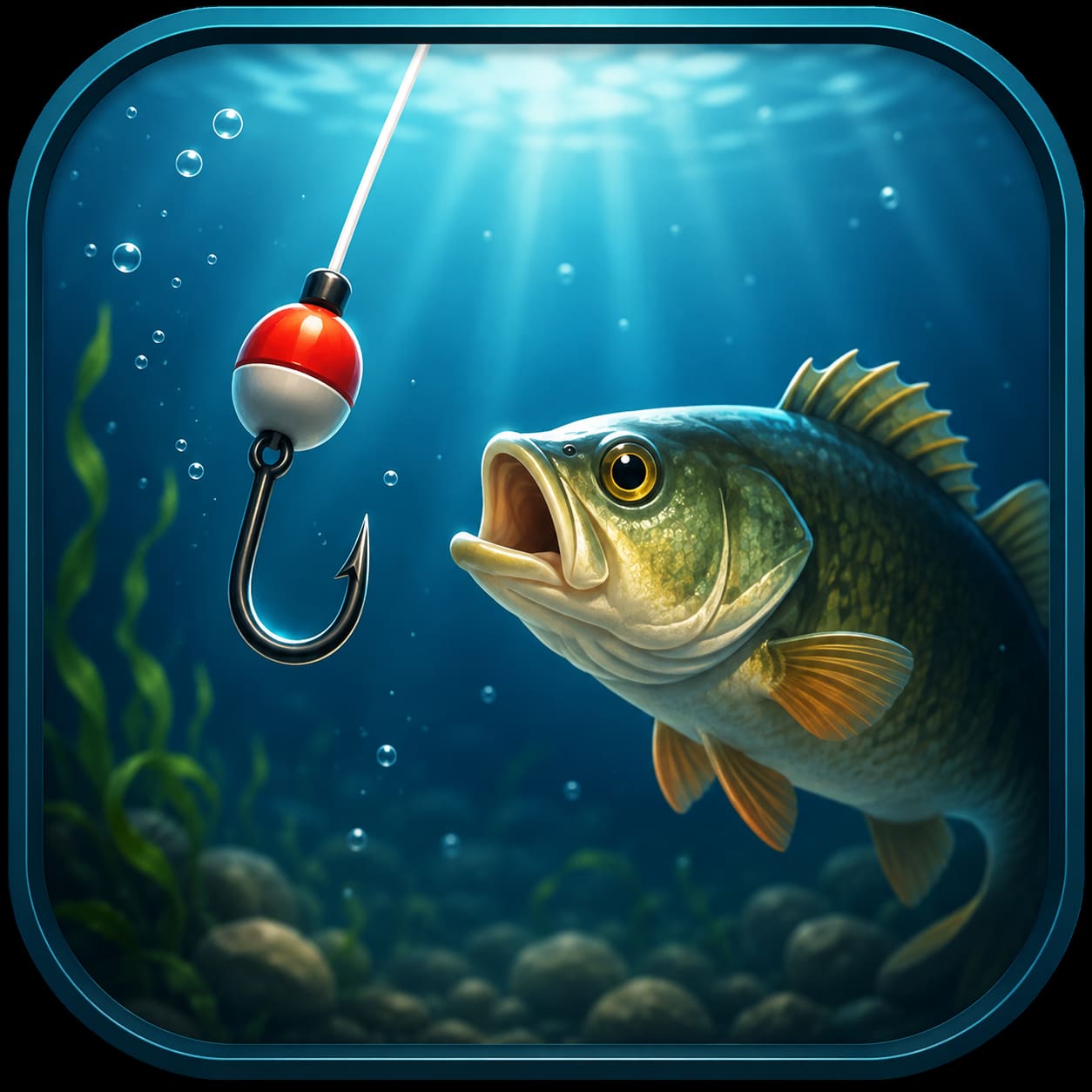
Bluewater is a free online deep-sea fishing game you play in the browser, with no download and no account. You work a single boat over a drowned coastline, dropping a lure through five bands of water and hauling back whatever takes it. The catch is that in this game a fish is not a number with a health bar - it is a set of instructions you have to read and answer, and answering wrong costs you the fish.
Everything starts with the lure. A lure hanging still catches nothing, so you jig it: short taps make it dart, and the more convincingly you work it the faster something comes up to look. When a fish finally commits you get a little over half a second to set the hook, and then the real job begins. You hold REEL to gain line and let go to give it back, and the tension bar across the top is the only thing standing between you and a broken line.
That is where the six kinds of fight come in. A runner like a bonito tears off in long bursts, and if you are still reeling when it goes the line parts - you have to let it run. A grouper does the opposite: it drives straight for the bottom, and over the wreck field it will reach the hull and cut you off, so playing it safe is exactly how you lose it. A barracuda shakes its head and has to be kept in a narrow middle band, because going slack throws the hook just as surely as heaving on it does. A sailfish telegraphs before it comes out of the water and you have to drop the tension for the jump. A halibut is dead weight that only comes up if you pump and reel in rhythm. A thresher spikes the line at random and you have to leave yourself room. Same button, six different answers.
Between the fights there is a working day to run. The livewell only holds a few fish, so keeping a good one can mean dumping a smaller one, and the light does not last forever. At the dock you sell what you brought back and buy gear - but every upgrade costs you something. Heavier line survives a hard run and also makes fish shy away from it. A stiffer rod tires a fish faster and sends every head shake straight to the hook. A smoother drag bleeds off the spikes on its own but claws back line more slowly. A bigger livewell holds more fish and the extra weight eats your daylight. There is no upgrade that is simply better, which is what makes the shop a decision instead of a checklist.
The water itself changes how you play, not just how it looks. Surface chop puts a swell into the line so the tension reading never sits still. The thermocline is cold and dim and the fish there are heavy and slow. The wreck field is full of structure that a diving fish will use against you. The trench is dark enough that nothing will rise to anything but a lamp, and a hundred metres of line stretches, so what you feel in your hands arrives late. Play free on desktop or phone - one thumb is enough.
Hold REEL - or the up arrow - to gain line, and let go to give line back. The space bar or the down arrow works DIVE, and L swaps the lure. Tap JIG, press J, or tap the water to work the lure; a lure that is not moving catches nothing. When a fish commits, the call changes to SET and you have a little over half a second to strike. From there the fight is the whole game, and it is not the same fight twice.
A runner tears off in long bursts and you have to let it go or the line parts. A diver drives for the bottom, and in the wreck field it will cut you off on the hull if you do not hold it hard - which means the safe play is the wrong play. A head-shaker has to be kept in a narrow middle band, because slack throws the hook just as surely as heaving does.
A jumper telegraphs before it comes out of the water and you must drop the tension for that moment. A bottom fish is dead weight that only comes up if you pump and reel in rhythm, and a spinner spikes the line at random. When it tires it comes to the boat and you tap GAFF on the beat. The livewell is small, so keeping a fish can mean dumping a smaller one.
Sell at the dock, then choose upgrades that all cost you something: heavier line survives a run but fish see it and bite less, a stiffer rod tires a fish faster but sends every head shake to the hook.
 ArcadeWhale