W/A/S/D or arrows to move · mouse to aim your light — on touch: left half for the stick, right half to aim
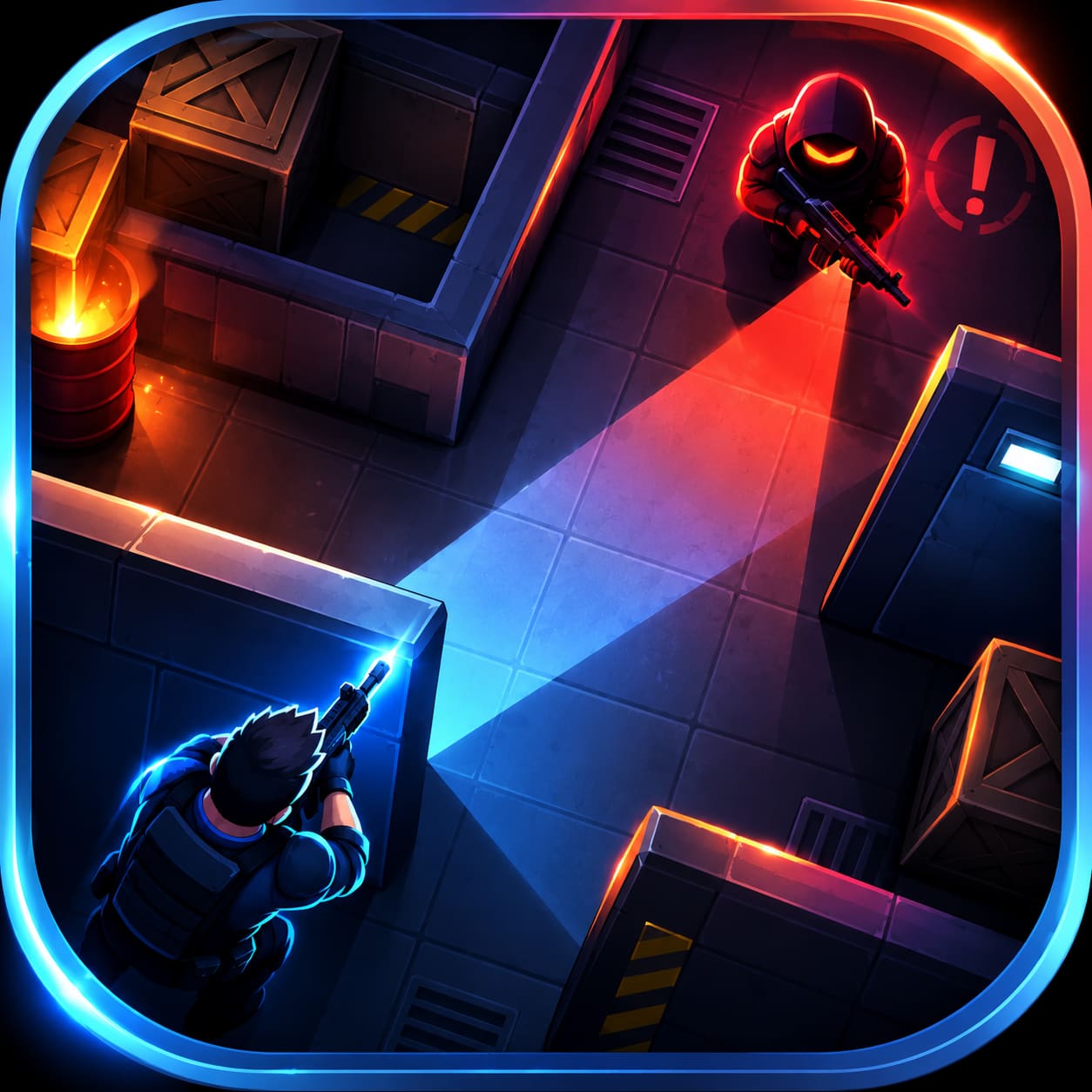
Blackout is a top-down tactical shooter played almost entirely in the dark. Your flashlight throws a narrow cone in front of you and that cone is all you get: walls block it, corners hide behind it, and a room you have not looked into might as well not exist. The whole game is built on that one restriction, because it applies to the guards as well as to you.
That symmetry is where the tension comes from. Every guard carries a light too, and their beams sweep across the same floor yours does. Long before a guard walks into view you will see his light crawl around a corner and slide over the ground in front of you, which tells you exactly what you need to know and nothing more: someone is there, roughly there, facing roughly that way. Reading those beams is the skill the game is really teaching, and it is the difference between walking into a room and waiting three seconds for the room to tell you what is in it.
There is no aim button. You fire automatically at any hostile your beam actually reaches, which means the question is never whether you can hit someone — it is whether you saw them first. Shooting a guard who has not spotted you does triple damage, so a fight you started from the dark is usually over in one burst, while a fight that starts with him seeing you is a fight you will probably lose. Positioning is the entire combat system.
Firing is not free, though. A gunshot is loud, and sound goes through walls that light cannot. The ring that expands from every shot shows you exactly how far that noise carried, and any guard inside it will come to look — not knowing where you are, but knowing where you were. Kill one guard carelessly and you have told three others roughly where to search, which is how a clean approach turns into a running fight.
Guards do not simply forget you either. Seeing you puts a guard on alert and he will chase; losing sight of you does not reset him, it drops him into a search around the last place he saw you, and only after that does he drift back to his patrol. Ducking behind a wall buys you a few seconds to reposition, not a fresh start.
Eleven hand-built missions run across four sectors, and each one introduces one idea rather than more of the last. The first sector is about light and corners. The second is about noise, where the maps open up and a single shot reaches further than you would like. The third simply puts more guards in your way and asks whether you have actually learned the first two. Some missions ask you to clear every hostile; others hand you a data cache to grab and an exit to reach, and leave it up to you how much shooting that involves.
The fourth sector changes what a guard is. Up to that point every beam has the same shape, so the only question a room asks is where to stand. Then you meet a searchlight, whose beam is thin but reaches half again as far as your own — it locks a corridor end to end, and the only way past is along its blind flanks or while it sweeps elsewhere. And you meet wardens, which are the exact opposite: a floodlight that covers everything within a few paces and sees nothing beyond that. A searchlight punishes you for walking towards it; a warden punishes you for getting close. Put one of each in the same building and every route becomes a trade.
Between missions you can spend credits on field gear — a longer beam, heavier plating, or an extra decoy. All are permanent, all are capped, and none of them shortens a mission for you.
You also carry two tools into every mission. A decoy is thrown where you are pointing and the noise pulls a guard over to investigate — it is the only way to move someone off a doorway without firing a shot, and it does not raise the alarm. Focus narrows your beam into a long thin one, so you read a corridor far earlier than usual; the cost is your peripheral vision, and anyone circling to your flank arrives unseen. Deciding which one a room needs is most of the game.
Live Duel drops two to four players into the same dark arena with identical kit. There is no loadout to master and no way to switch your light off, so the tension is the same one the campaign teaches, turned on another person: the beam that lets you see is the beam that says where you are. A shot from an angle your target never checked does triple damage, which means a duel is usually decided before either player fires. Narrow your beam to watch a long corridor and your flanks go blind; widen it to cover the room and you light yourself up from further away. Quick Match finds opponents automatically, or you can share a room code and settle it with a friend.
It runs in the browser with nothing to install, works with a keyboard or by dragging anywhere on a touchscreen, and remembers the mission you reached.
Move with WASD or the arrow keys and point your light with the mouse - the mouse never moves you, it only aims. On a phone, press the left half of the screen for a movement stick and the right half for an aim stick. There is no fire button: you shoot automatically at any hostile your beam actually reaches, so the game is about where you stand and which way you face. Shooting someone who has not spotted you does triple damage.
SHIFT holds FOCUS, narrowing your beam into a long thin one; SPACE throws a decoy, whose noise pulls a guard away without raising the alarm. Every shot is loud and the ring shows how far the sound carried; enemies hear through walls even though they cannot see through them. Watch for enemy beams sweeping the floor - a thin long one is a searchlight, a wide short one is a warden.
Live Duel puts two to four players in the same dark arena with the same kit: there is nowhere to hide, because the beam that lets you see is the beam that shows where you are, and the first shot from an unseen angle does triple damage.
 ArcadeWhale